Yandex.Metrica
AI Defense Systems · Skolkovo Resident

UAV Protection:
two products
for your task

LLC "Neurotech" develops solutions for detecting and neutralizing unmanned threats: the hardware-software system "Huntsman" and the software "Anti-Drone". Choose exactly what you need.

Our products

Two products — one mission

We offer two independent solutions for protection against drones. Choose the right one — a complete active defense system or a software drone detector.

Hardware-software system

APK "Huntsman"

An autonomous active defense system. It closes the "detection → tracking → engagement" loop for an aerial target without human involvement.

  • Full cycle from detection to target neutralization
  • Neural network recognition and precise turret targeting
  • Kinetic engagement and laser suppression
  • Scales up to 8 turrets and 160° sector sensors

Who it is for: fuel and energy facilities, critical infrastructure, and military sites where active threat neutralization is required.

More about APK "Huntsman"
Software

"Anti-Drone" Software

A software UAV detector based on convolutional neural networks. It detects and identifies drones in real time from the video feed of ordinary cameras.

  • Works with existing surveillance cameras
  • Automatic detection and identification of UAVs
  • SMS and messenger alerts, detection log
  • Registered with Rospatent (cert. No. 2023660446)

Who it is for: facilities that need a software module for early detection and alerting — without a weapons component.

More about "Anti-Drone" Software

How the products are related: "Anti-Drone" Software is the detection "core" that is also used within APK "Huntsman". You can start with software-based detection and alerting and later expand the system into a complete active defense complex.

Product 1

APK "Huntsman"

A hardware-software active defense system against unmanned aerial vehicles — a full cycle from detection to target engagement.

Current threat

An asymmetric threat to the security of fuel and energy facilities

In recent years, fuel and energy facilities and critical infrastructure in Russia have been subject to systematic attacks using unmanned aerial vehicles. Traditional air defense and electronic warfare systems are often economically ineffective against the mass use of cheap UAVs.

The main difficulty of interception lies in the low visibility of drones, their high maneuverability, and their low cost. Engaging a maneuvering FPV drone with small arms is an extremely difficult task even for professional shooters, as confirmed by specialized tests.

Limited effectiveness of manual interception

In practice, engaging a drone with firearms even at close range is a serious challenge even for an experienced competitive shooter .

* Video demonstration of the difficulty of intercepting an FPV drone by a world-class specialist.

Low visibility

Compact dimensions and special coatings make UAV detection by traditional means difficult

High maneuverability

Speed and the ability to change trajectory abruptly make drones difficult targets

Economic asymmetry

The low cost of attacking UAVs makes the use of traditional air defense systems economically unviable
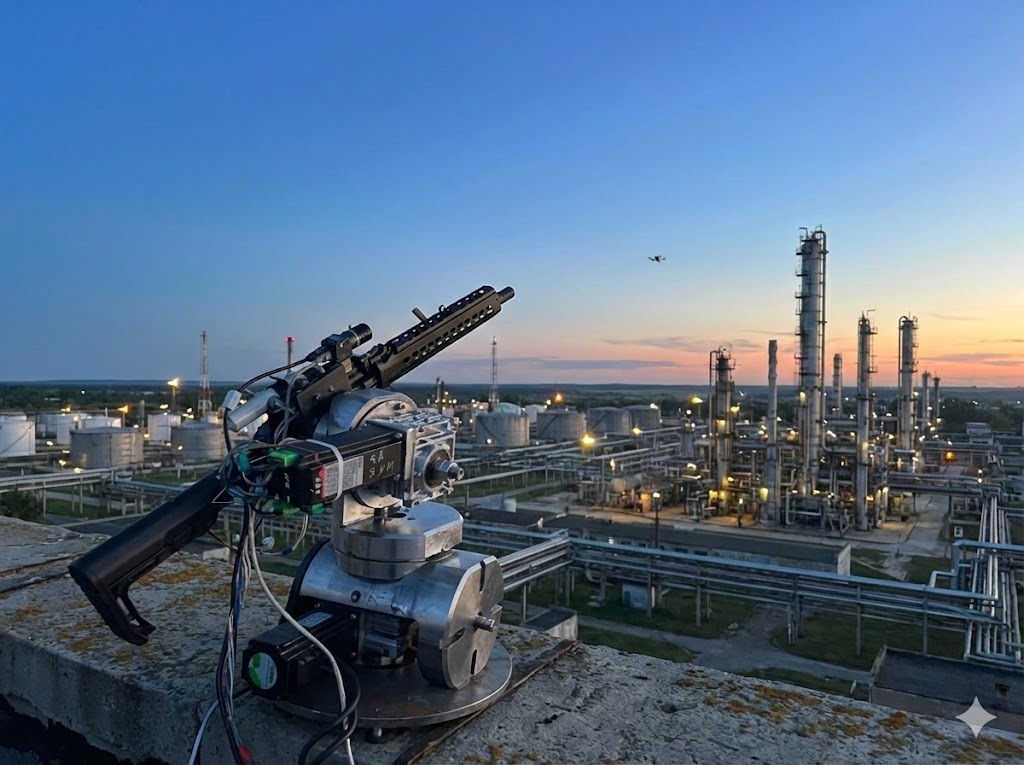
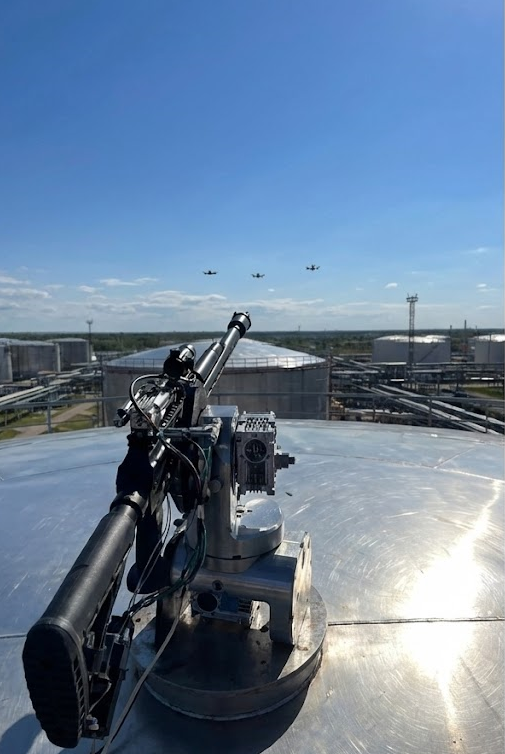
Skolkovo Innovation Project

APK "Huntsman": An autonomous active defense system

Developed within the project "Anti-Drone Turret" at Skolkovo , the system closes the "detection-engagement" loop without human involvement

How the system works

The APK "Huntsman" hardware-software system is an integrated solution capable of searching for, identifying, tracking, and neutralizing aerial threats in real time in fully automatic mode.

The system analyzes video feeds from surveillance cameras using computer vision algorithms based on neural network models trained to recognize a wide range of UAVs under various weather and lighting conditions.

Autonomous operating cycle

Full cycle from detection to engagement without operator intervention

Integration with existing infrastructure

Works with CCTV cameras and perimeter control systems

Flexible architecture

A modular design allows the system to be adapted to specific tasks

Demonstration of how the system works

Artificial intelligence

Neural network algorithms based on domestic FPGAs using residue number systems (RNS) to accelerate computation

Precise targeting

A servo drive system with sub-pixel positioning accuracy and compensation for external disturbances

Multi-layered protection

Combined use of kinetic engagement and laser blinding for various threat scenarios

Optical recognition based on artificial intelligence

The "Huntsman" computer vision system provides detection and classification of UAVs at ranges of up to 4 km

Live Test

Recognition of a small-sized UAV

Demonstration of computer vision algorithms detecting a DJI Mini 3 drone measuring 25×36 cm. The system reliably detects the target at a range of 300 m.

Screencast

Software interface

Screencast of the "Huntsman" software in operation. On the left is the processed video feed with highlighted targets; on the right is the original image from a Beward camera. The algorithms detect targets that are almost invisible.

Detection performance characteristics

Камера 8 МП, условия: дневное время, видимость > 10 km

UAV class / Target type Dimensions Detection range
FPV drone (copter)
30 × 30 cm 300 m
"Baba-Yaga" (multirotor)
95 × 95 cm 1,200 m
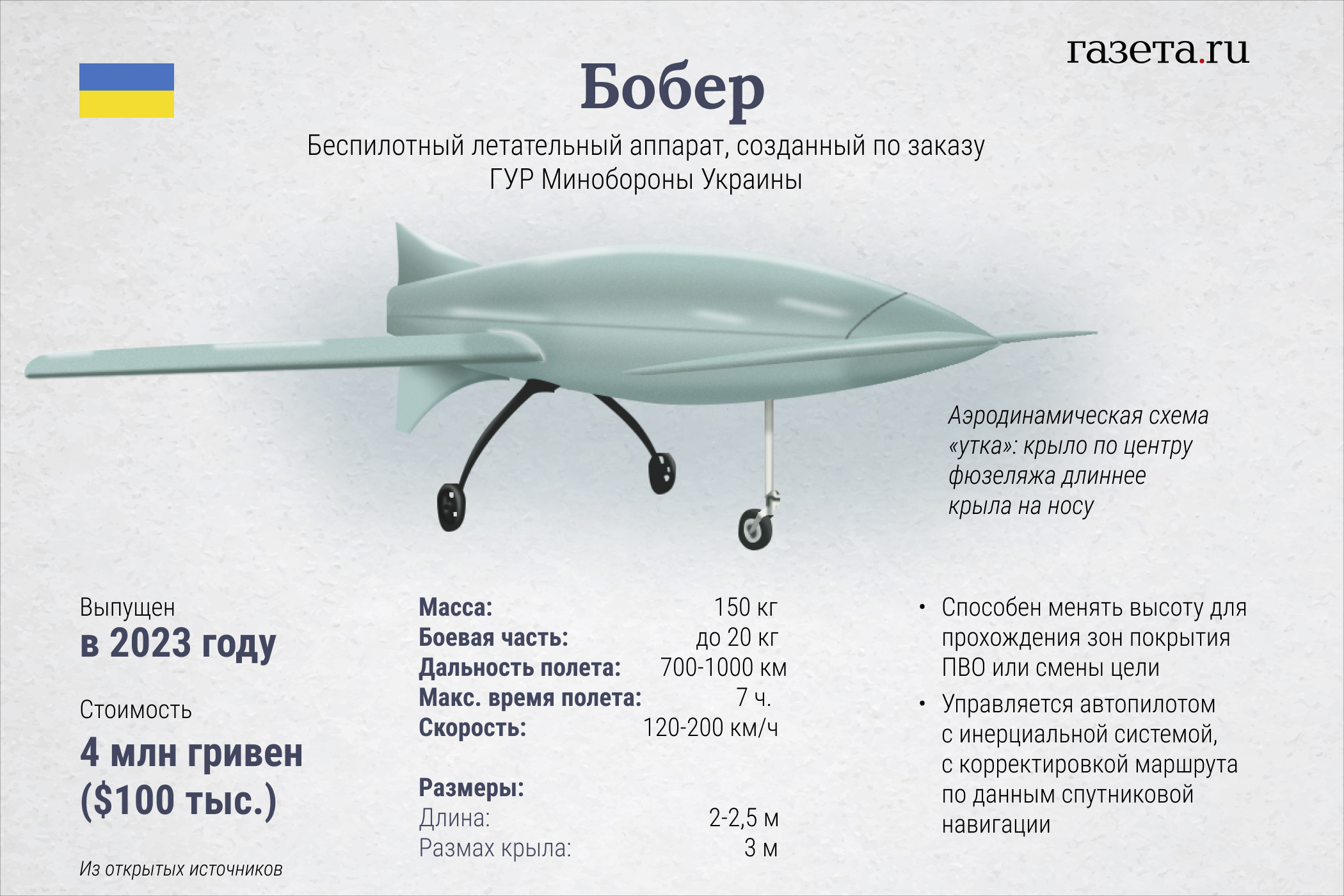
UAV "Bober"
2.0 × 3.0 m 2,400 m
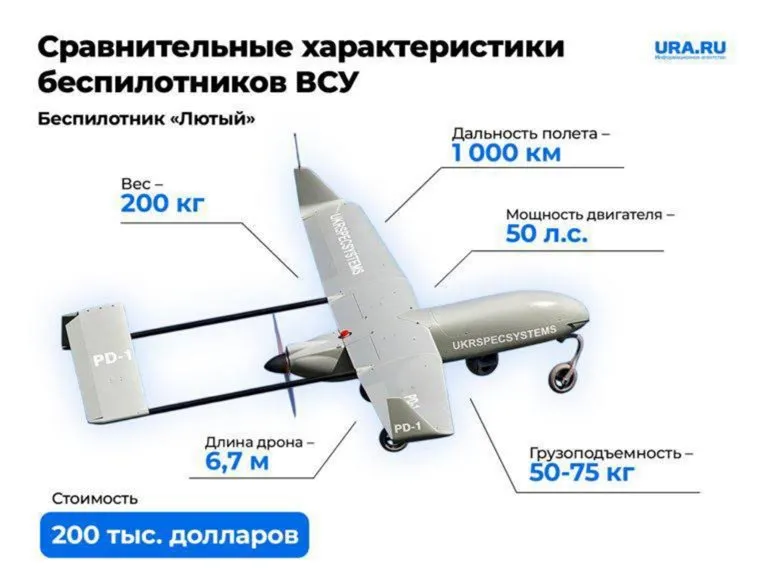
UAV "Lyuty"
4.4 × 6.7 m 4,000 m

Дальности указаны для условий уверенного обнаружения (вероятность > 95%). Due to the absence of "Bober" and "Lyuty" samples, the tests were carried out with analogues of corresponding dimensions.

Laser suppression of UAV optical systems

Given the legal restrictions on the use of firearms in the civilian sector, we have developed a system for blinding the opto-electronic systems of UAVs using directed laser radiation.

Laser Test 1

Operation of the laser array prototype on a Beward PTZ camera controlled by the "Huntsman" software

Laser Test 2

Footage from a drone during laser blinding — the glare effect on video sensors

Tactical effect of use

Laser exposure of drone camera sensors causes their temporary or permanent blinding, which significantly impedes the operator or the UAV's autonomous guidance system, creating a critical time window for countermeasures.

Unlike kinetic engagement, the use of laser systems against UAVs is not restricted by the current legislation of the Russian Federation , which opens up the possibility of their widespread use to protect civilian critical infrastructure facilities.

No projectile fragments

No risk of damage to your own infrastructure or personnel

Instant effect

The speed of light ensures an immediate effect

Legal admissibility

Full compliance with the legislation of the Russian Federation

Low cost per shot

Cost-effective compared to traditional means

Mobile turret prototype "Huntsman"

The turret prototype design was developed to overcome the limitations of PTZ-camera-based systems, to tune the PID coefficients of the servo motors, and to conduct full-scale field tests.

APK "Huntsman" in operation

APK "Huntsman" prototype

Screencast of optimizing the counter-mode against fixed-wing drones

Screencast of optimizing the counter-mode against FPV drones

Universal platform based on a Weaver/Picatinny rail

A standardized mount for various engagement means

APK "Huntsman" is equipped with a standard Weaver/Picatinny Rail mount, allowing the use of a wide range of standard and special weapons, as well as laser engagement systems.

A submachine gun mounted on the APK Huntsman platform

Submachine gun

Minimal recoil.

Click to enlarge
A Saiga 12-gauge semi-automatic carbine on the APK Huntsman platform

"Saiga"/"Vepr" carbine

12-gauge semi-automatic

Click to enlarge
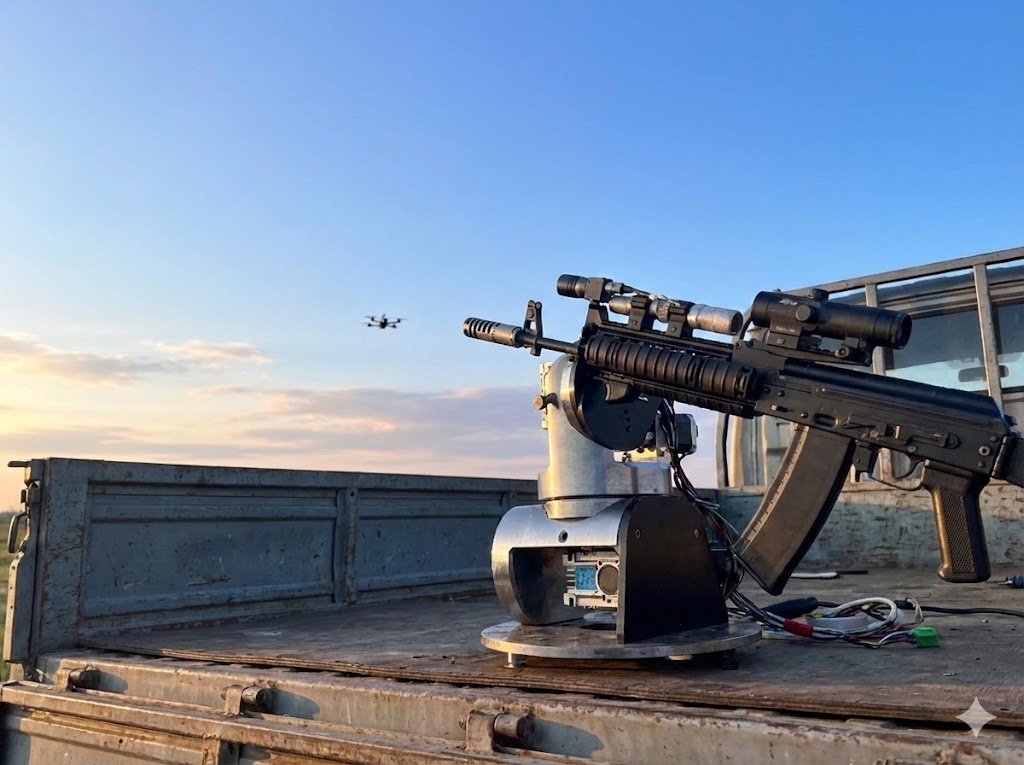
An AK platform on the APK Huntsman system for engaging UAVs

AK platform

A classic design with proven reliability

Click to enlarge

Click an image to enlarge

System deployment and scaling

The flexible architecture of APK "Huntsman" allows the system to be adapted to various application scenarios and protection to be scaled to facilities of any complexity

1 km²
Standard security module
160°
Field of view of each video sensor
8
Autonomous turrets in the ring
+200 m
Turret offset beyond the perimeter
< 2 s
From detection to opening fire

Modular defense architecture

The architecture of APK "Huntsman" is built on a modular principle and provides seamless scaling of perimeter protection. Deployment is based on a standardized security module with an area of 1 km².

The central node of the system is the management server, which aggregates data streams from the corner video sensors. The sensors, with a field of view of 160° form zones of overlapping observation, eliminating "blind spots" and providing stereoscopic detection accuracy within the perimeter.

The outer active defense perimeter is formed by a network of 8 autonomous turrets, offset by 200 meters from the perimeter fence. When a UAV is detected, the server computes a ballistic solution and issues an interception command to the turrets closest to the target.

System software
ПЕРИМЕТР · 1×1 КМ СЕРВЕР АПК Т1 Т2 Т3 Т4 Т5 Т6 Т7 Т8 БПЛА
Perimeter 1×1 km Server and 160° sensors Turret (+200 m offset) Target and lines of fire

How interception works

The full cycle from the appearance of a target to its neutralization takes less than two seconds and runs without operator involvement.

1

Detection

The 160° video sensors register a moving object within the overlapping observation zone.

2

Identification

The neural network classifies the target and filters out false positives — birds, vehicles, and interference.

3

Ballistic computation

The server computes the lead and selects the turrets closest to the target's trajectory.

4

Interception

The selected turrets open fire on the target. Response time is less than 2 seconds.

APK Server

Centralized management and AI analytics: processing sensor data and coordinating all turrets.

160° sensors

Overlapping observation with 4x coverage of the central zone — no blind spots.

8 turrets

All-round defense on distant approaches. The 1 km² module scales to a facility of any area.

Response < 2 seconds

A direct link between the server and the turrets ensures instant interception from the moment of detection.

Software Registry

"Huntsman" Software in the Unified Register of Russian software

The software component of the system is registered as the computer program "Huntsman. Recognition and Targeting" — the control core of APK "Huntsman".

Certificate No. 2025611484 Skolkovo Resident Version 1.0

Brief description

"Huntsman. Recognition and Targeting" is the control software of the APK "Huntsman" hardware-software system. In fully automatic mode it provides detection and classification of unmanned aerial vehicles from a video feed, target tracking, lead computation, and the targeting of rotating turrets equipped with kinetic and laser engagement modules.

Developed by LLC "Neurotech", a resident of the Skolkovo Innovation Center. Unlike the "Anti-Drone" Software (detection and alerting only), the "Huntsman" Software closes the full "detection — tracking — engagement" loop for an aerial target without operator involvement.

Functional characteristics

UAV detection and classification

Analysis of the video feed by a convolutional neural network, recognition of a wide range of UAVs under various weather and lighting conditions.

Tracking and targeting

Target tracking, lead computation, and turret targeting via a servo drive system with sub-pixel positioning accuracy.

Engagement control

Control of kinetic firing platforms and the laser module for suppressing UAV optical systems.

Centralized management

A single APK server controls up to 8 turrets and 160° sector sensors, uniting them into a single protected loop.

Autonomous mode

A full cycle from detection to engagement without operator intervention. The response time from detection to opening fire is less than 2 seconds.

Infrastructure integration

Works with CCTV cameras and existing perimeter control systems. A modular architecture tailored to the specific tasks of the facility.

Technical specifications

Platform APK server based on a PC with an NVIDIA GPU (CUDA)
Operating system Linux (Debian/Ubuntu)
Programming languages C++, CUDA, Python, SQL
Connectable turrets up to 8 per server
Sensor field of view 160° (sector coverage)
Response time less than 2 seconds

Installation and operation documentation

Technical documentation describing the functional characteristics and the information required to install and operate the "Huntsman" Software.

Pricing and delivery terms

Terms for granting a license to use the "Huntsman" Software.

The "Huntsman" Software is supplied under a delivery agreement and/or a license agreement concluded with LLC "Neurotech". The price is determined individually and depends on the system configuration (the number of turrets and sensors), the type of engagement modules, the technical support terms, and additional integration options.

Requesting a commercial proposal

To calculate the price for your facility's tasks, send a request to 1@neurotech.pro or by phone +7 (902) 642-86-58. Please specify the type of facility, the area of responsibility, and the required number of turrets.

Warranty obligations

The warranty period for the "Huntsman" Software is 12 (twelve) months from the date the acceptance certificate is signed, including the release of updates and advisory support for the customer's specialists.

Software copy for expert review

A demonstration build of the "Huntsman" Software for interface evaluation and expert review.

A link to the demonstration copy of the "Huntsman" Software is provided on request — including for expert review purposes in the Unified Register of Russian Computer Programs.

Request a software copy

"Huntsman" Software rights holder

Rights holderLimited Liability Company "NEUROTECH"
Registered address58V Gagarina Blvd., apt. 25, Perm, 614077, Russia
TIN5906172713
KPP590601001
PSRN1225900006155 dated 30.03.2022
Official website https://neurotech.pro

The website belongs to LLC "Neurotech". A document confirming ownership is provided on request as part of the application package.

Name of the computer program"Huntsman. Recognition and Targeting"
Program authorsS.P. Sivkov, A.V. Shalimov
Product 2

Software "Anti-Drone"

A software detector of unmanned aerial vehicles based on convolutional neural networks — detection and alerting without a weapons component.

Software Product

Software "Anti-Drone"

An optical-thermal detector of unmanned aerial vehicles based on convolutional neural networks. The software recognition module underlying APK "Huntsman".

Certificate No. 2023660446 Skolkovo Resident Version 1.0

Brief description

The "Anti-Drone" Software is an integrated software solution that, in fully automatic mode, searches for and identifies unmanned aerial vehicles (UAVs) in real time from the video feed of fixed optical and thermal cameras.

Developed by LLC "Neurotech", a resident of the Skolkovo Innovation Center. It is designed to protect fuel and energy facilities, critical infrastructure, and industrial and military sites against mass attacks using fixed-wing and multirotor UAVs, including FPV drones. It is applicable in stationary and mobile configurations.

Functional characteristics

Automatic UAV detection

Continuous analysis of the video feed from fixed cameras by a convolutional neural network optimized for NVIDIA GPUs (CUDA, cuDNN, TensorRT). Filtering of false positives within the area of responsibility.

Personnel alerting

Notifying the operator of a detection by sending SMS and/or messenger messages. Transmission of a snapshot frame and a timestamp at the moment of detection.

Detection log

Maintaining an event log with the ability to review the detection history. A snapshot frame is saved for each event in the "Detection History" and "Recent Detections" tabs.

Modular architecture

Server and interactive (workstation) operating modes. The basic deployment unit is a standardized security module covering 1 km². Clustering is supported to protect larger facilities.

Stationary and mobile configurations

Perimeter protection from 1 km² (fuel and energy facilities, warehouses, airfields, logistics terminals). Installation on vehicles and armored vehicles to detect FPV drones while moving.

Archiving and a portal to the photo archive

Export of frames with detected UAVs to a file system, an SQL server, or a CEPH cluster. Streaming via RTSP servers. A shared SQL backend with client notification and a REST API on Flask/FastAPI to combine multiple detection servers into a single portal.

Technical specifications

The detection range depends on the linear dimensions of the target and the quality of the video feed. The values in the table are given for typical lighting and visibility conditions.

UAV class Dimensions Detection range
FPV drone (copter) 30 × 30 cm 300 m
"Baba-Yaga" (multirotor) 95 × 95 cm 1,200 m
UAV "Bober" 2.0 × 3.0 m 2,400 m
UAV "Lyuty" 4.4 × 6.7 m 4,000 m

System requirements (workstation module)

Minimum

CPU 8 cores, ≥ 2 GHz
RAM 8 GB
GPU (CUDA) NVIDIA RTX 3070
OS Linux (Debian/Ubuntu)

Recommended

CPU 8 cores, ≥ 2 GHz
RAM 16 GB
GPU (CUDA) NVIDIA RTX 5070
OS Linux (Debian/Ubuntu)
Programming languages C++, CUDA, TIS, Python, SQL, HTML
Computer type IBM PC-compatible
Delivery format deb package (antidron-1.0_1.deb)

"Anti-Drone" Software in operation

Simultaneous detection of five UAVs within the area of responsibility — each target marked with a red detection box, camera previews, and the detection log

Fig. 1. Multi-target mode: five UAVs are simultaneously detected and tracked by the neural network within the area of responsibility against a complex cloudy background. Each target is marked with its own red detection box. On the left are the previews of cameras No. 1–4 and the "Detection History" log.

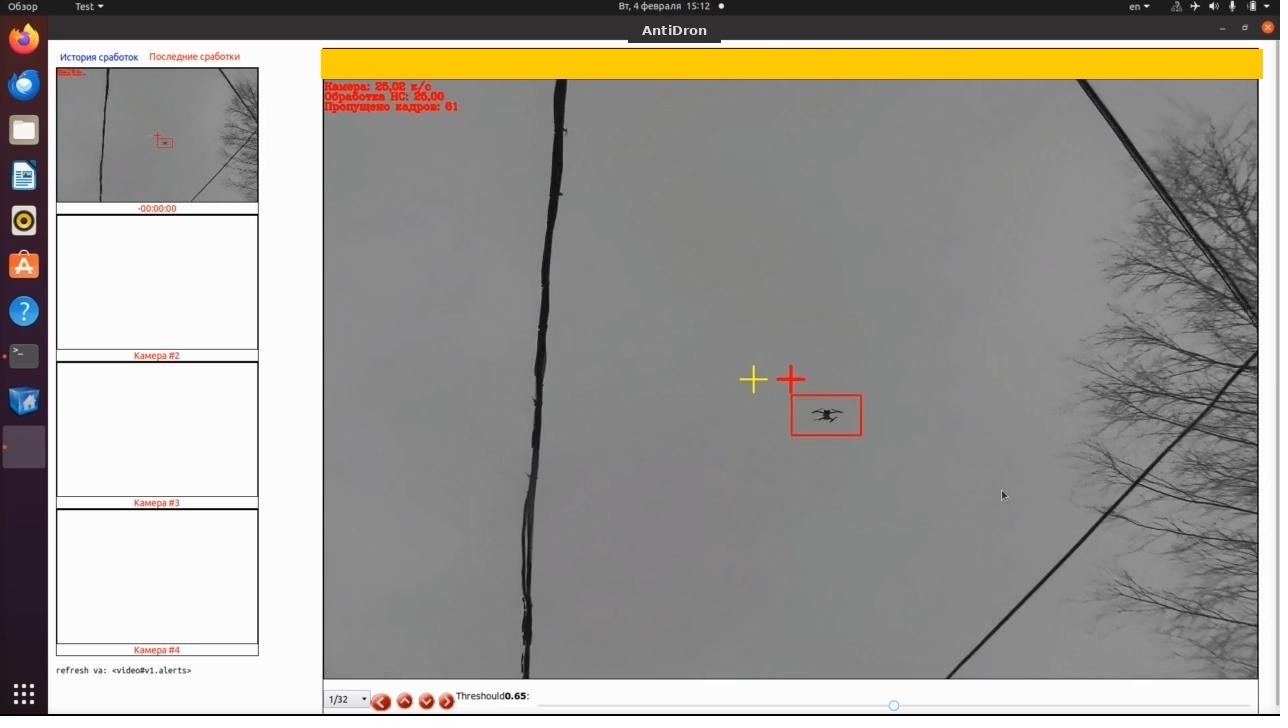
The graphical interface of the Anti-Drone Software — a drone in a red detection box, turret aiming crosshairs, camera previews, the detection log, and system telemetry

Fig. 2. The main screen of the "Anti-Drone" Software. A UAV is captured in a detection box; the turret's aiming crosshairs (yellow — target, red — current) are converging on the target. The left panel shows the previews of cameras No. 1–4 and the "Detection History" log. At the top is the system telemetry (camera FPS, neural network FPS, number of dropped frames).

UAV recognition by the neural network against a complex background — a house, greenhouses, forest, and a grey cloudy sky

Fig. 3. UAV recognition against a complex background: a residential house, greenhouses, a tree line, and a grey cloudy sky. The neural network reliably marks the target with a red box; the telemetry shows 9.72 fps from the camera and 2.51 fps of neural network processing.

Detection of a low-visibility target at long range — a tiny UAV dot in a red detection box against a cloudy sky

Fig. 4. Detection of a low-visibility target at long range. A UAV only a few pixels in size is reliably detected by the neural network. At the bottom are the service parameters of the PTZ camera (Pan/Tilt/Zoom): P028/T008 Z001.

Target tracking with aiming crosshairs — a UAV in a red detection box, the crosshairs converged on the target, with trees and a power line pylon in the background

Fig. 5. Real-time target tracking. The aiming crosshairs are converged on the UAV, and the detection box stays on the maneuvering target. Stationary objects (a power line pylon, trees) are correctly filtered out as false positives.

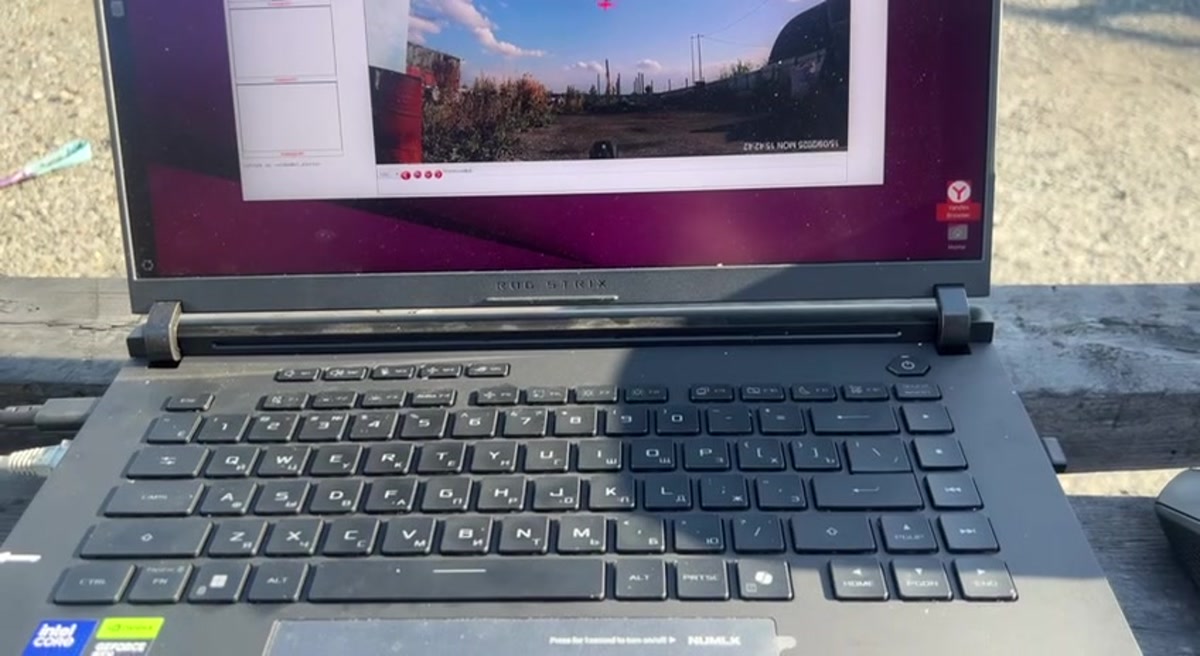
Field deployment of the Anti-Drone Software — the workstation module installed on an ASUS ROG Strix laptop directly at the protected facility

Fig. 6. Field deployment of the standard workstation module of the "Anti-Drone" Software. It is delivered as a deb package and deployed on a standard laptop with an NVIDIA GPU directly at the protected facility — without a server rack and without major installation work.

Pricing and delivery terms

Terms for granting a simple (non-exclusive) license to use the "Anti-Drone" Software.

The "Anti-Drone" Software is supplied under a delivery agreement and/or a license agreement concluded with LLC "Neurotech". The license price is determined individually and depends on:

  • the chosen delivery configuration — the client version (workstation module, up to 4 video sensors) or the server version (up to 128 video sensors);
  • the number of deployed modules and workstations;
  • the license term and the technical support terms;
  • additional options (specialized neural networks, integration with the customer's systems, an on-site visit by a developer's specialist).

Requesting a commercial proposal

To receive a commercial proposal with specific prices for your facility's tasks, send a request to 1@neurotech.pro or contact us by phone +7 (902) 642-86-58. In your request, please specify the type of facility to be protected, the area of responsibility, and the number of video sensors.

Warranty obligations

The warranty period for the "Anti-Drone" Software is 12 (twelve) months from the date the acceptance certificate is signed. During the warranty period, LLC "Neurotech" provides the release of updates that fix identified errors, as well as advisory support for the customer's technical specialists.

Software copy for expert review

A demonstration build of the "Anti-Drone" Software for evaluating the user interface and conducting an expert review.

Contents of the demo build

  • deb package antidron-1.0_1.deb
  • checksums (SHA-256)
  • installation and startup instructions
  • test video clips with UAVs

Demo version limitations

  • runs on CPU only (no GPU)
  • artificially limited recognition range
  • reduced detection quality
  • limited turret control functions

Access to the software copy

A link to the demonstration copy of the "Anti-Drone" Software is provided on request — including for expert review purposes in the Unified Register of Russian Computer Programs. To obtain the link, send a request:

"Anti-Drone" Software rights holder

Rights holder Limited Liability Company "NEUROTECH"
Registered address 58V Gagarina Blvd., apt. 25, Perm, 614077, Russia
TIN 5906172713
KPP 590601001
PSRN 1225900006155 dated 30.03.2022
Official website https://neurotech.pro

The website belongs to LLC "Neurotech". A document confirming ownership is provided on request as part of the application package.

Skolkovo registration number 1125247
Program authors S.P. Sivkov, A.V. Shalimov, M.A. Shalimova, M.A. Terekhova, A.A. Shalimov, B.A. Shalimov
In Development

Future developments

Armored vehicle protection

A mobile active protection module against FPV drones for installation on armored vehicles. Autonomous detection and engagement of approaching drones before they reach the protected object.

More in the analytical report →

Interceptor drone "Free Hunter"

An autonomous UAV launched toward the threat that engages the target by ramming or with a special net, without the need for a constant link to the operator. It can operate under electronic jamming conditions.

More about the project →

The "Servitor" project

The "Servitor" project aims to create a hardware-software system for accelerating neural network computation based on domestic processors. In the future it will make it possible to replace imported platforms (NVIDIA) in APK "Huntsman" with Russian equivalents, ensuring technological independence.

More about the project →

Night-time recognition

To detect drones at night, in cooperation with the "Atom" R&D company we have recorded a significant amount of thermal-imaging footage of drones. A dataset for AI training will soon be labeled, and APK "Huntsman" will gain "night vision".

Intellectual Property

Intellectual property results

For developments on these topics, our team has obtained the following certificates and patents

Certificate of state registration of the computer program "Anti-Drone"

No. 2023660446 dated 19.05.2023

Authors: S.P. Sivkov, A.V. Shalimov, M.A. Shalimova, M.A. Terekhova, A.A. Shalimov, B.A. Shalimov

Rights holder: LLC "Neurotech"

Certificate of state registration of the computer program "Iskatel" FPGA code generation program

No. 2023680866 dated 06.10.2023

Authors: S.P. Sivkov, A.V. Shalimov

Rights holder: LLC "Neurotech"

Certificate of state registration of the computer program "Roboline"

No. dated 08.12.2023

Authors: M.A. Terekhova, S.P. Sivkov, A.V. Shalimov, B.A. Shalimov

Rights holder: LLC "Metakom-Alpha"

Certificate of state registration of the computer program "Huntsman. Recognition and Targeting"

No. 2025611484 dated 20.01.2025

Authors: S.P. Sivkov, A.V. Shalimov

Rights holder: LLC "Neurotech"

Invention patent RU No. 2 813 389

"Device for protection against unmanned aerial vehicles" dated 12.02.2023

Authors: S.P. Sivkov, A.V. Shalimov, S.S. Bazhin

Rights holder: LLC "Neurotech"

Eurasian invention patent No. 050614

"Method of digital image processing" dated 30.06.2025

Authors: S.P. Sivkov, S.P. Shalimov

Rights holder: LLC "Neurotech"

Eurasian invention patent No. 049482

"Neural network video stream processing with hardware inference implementation based on RNS" dated 28.03.2025

Authors: S.P. Sivkov, S.P. Shalimov

Rights holder: LLC "Neurotech"

Total protected developments

Our team continues to work on new patents

7
Results

Cooperation and implementation prospects

We are interested in implementing the full cycle from development to mass production of the UAV protection system

Completion of R&D

Development of a complete AI-based counter-UAV system capable of detecting, tracking, and engaging aerial targets in fully automatic mode, including the use of laser technologies.

Pilot deployment

Deployment of prototype systems at customers' facilities, conducting field tests in real conditions, eliminating identified shortcomings, and optimizing the system to meet specific customer requirements.

Mass production

Organizing the mass production of protection systems and supplying them to fuel and energy facilities and critical infrastructure. We are considering various forms of cooperation, including the creation of joint ventures.

Contact information

LLC "NEUROTECH" | Resident of the Skolkovo Innovation Center

Company details

Full name

Limited Liability Company "NEUROTECH"

TIN

5906172713

KPP

590601001

Director

Anton Vladimirovich Shalimov